Why Sociology?
You can’t change the world without understanding it. You can’t understand society without engaging with it. Sociology provides you with the tools to understand individuals, organizations, institutions, and societies. And reveals the power of social action.
Why study Sociology?
-
Sociology equips students with the tools and frameworks to meaningfully answer their questions about the world, and ask the right questions. Our students are drawn to sociology because they...
- want to understand the social forces that shape their own lives
- want to make sense of how society is (or isn’t) changing
- often ask “why” questions about how the world works
- are concerned about inequity & want to understand it to dismantle it
- are passionate about a particular issue and want to help fix it
-
Our students' curiosity about the world is the springboard for developing skills to become valuable contributors both on the job and in the heart of the community. These include...
- critical thinking and problem solving skills
- social awareness and advocacy
- cultural competence
- research and data analysis skills
- effective communication
- skills to be an informed citizen who can actively participate in shaping their neighborhoods, towns and cities
-
With a sociology degree, students are prepared to navigate an ever-changing job market. Sociology opens doors to careers and graduate programs in wide ranging settings, like...
- healthcare
- law and criminal justice
- education
- social work
- research
- business
- marketing/public relations
- government/politics
- non-profits/public service/international relations
- human resources
The Nuts and Bolts: What is it like to study Sociology at UIC?
-
The Nuts and Bolts: What is it like to study Sociology at UIC? Here's how we set it all up for you to succeed:
The Nuts and Bolts: What is it like to study Sociology at UIC?
The Nuts and Bolts: What is it like to study Sociology at UIC? The classes you take will help you hone your ‘sociological imagination,’ which is a framework that helps you see the world from many different perspectives, and ultimately leads you to understand how individuals and all kinds of institutions are connected (and how each affect the other).
The Basics
As a sociology major or minor, you will learn the basics of sociology (in introductory courses like Soc. 100/105), and the tools of sociology (theory, methods and stats). Then you get to dig deeper into classes on specific topics like: health and medicine, race/ethnicity, gender/sexuality, children and youth, migration, organizations, work and the economy, and politics. The 200-level courses give you the big picture of a topic, and the 400-level courses let you dig even deeper into a particular topic you’re really interested in.
Classes to help you launch
We bookend the major with classes that specifically prepare you for being successful in the major (Soc 290) and for being successful once you graduate (Soc 490). See the “How does sociology prepare me for the future” tab, below.
Personalize your journey
There is plenty of room in the major to carve your own pathway, based on your interests. We even have ‘concentrations’ if you have a specific interest. Concentrations provide guidance choosing classes and help you stand out to employers and graduate schools. Check out the list of concentrations here.
Sociology is also a great major to pair with other majors. Check out our section on double majors below.
Experts
Our professors and graduate instructors are experts in social inequality across all areas of social life (politics, education, organizations, the economy, cities, countries, healthcare), and many different dimensions (race/ethnicity, gender/sexuality, immigrant status). We conduct research using qualitative (ethnographic and interviews) and quantitative (surveys, statistics, ‘big data’) methods and make innovative theoretical contributions to how we understand the world.
Engaged
Your professors are passionate about sociology, and eager to share their sociological imagination with you. We’re a unique department (among other sociology departments around the U.S.) because of our faculty and graduate students’ commitment to applying their sociological lens to ‘real world’ issues. Our faculty often partner with non-profit and advocacy groups to address pressing social issues like immigration, police violence, residential segregation, COVID-19, and many others. This means you get to learn from sociologists who both publish field-defining books and articles, and care about making that research relevant to solving society’s problems. This also means you will learn how to use your sociology in the ‘real world!’
Enthusiastic
Faculty in UIC Sociology do lots of things in addition to teaching undergraduate courses (mentoring and teaching graduate students, conducting research, community engagement, helping make the department and university run smoothly). But teaching and mentoring undergraduates is one of the most rewarding parts of our job, and we bring that passion into our classrooms and advising.
How does Sociology prepare me for the future?
-
How does Sociology prepare me for the future? Here's how we prepare you, each step of the way:
The Beginning
Sociology 290. To make sure you get off on the right foot, as soon as possible in your sociological journey you will take Sociology 290. This class will introduce you to resources and opportunities (in the department and throughout campus) to help you make the most of your sociological journey at UIC. We will also help plant the seeds for what you’ll want to do after you graduate!
The Middle (Research Opportunities)
Students with an interest in getting hands-on research experience with graduate students and faculty have two ways to do this. Every year, we offer the Graduate-Undergraduate Research Practicum (GURM) program, which pairs undergraduate student research assistants with graduate students conducting their PhD research. If you are interested, be sure to attend the meetings when you see the announcements! Also, the department shares information about research opportunities on a regular basis through its emails and social media.
The Middle (Department Events)
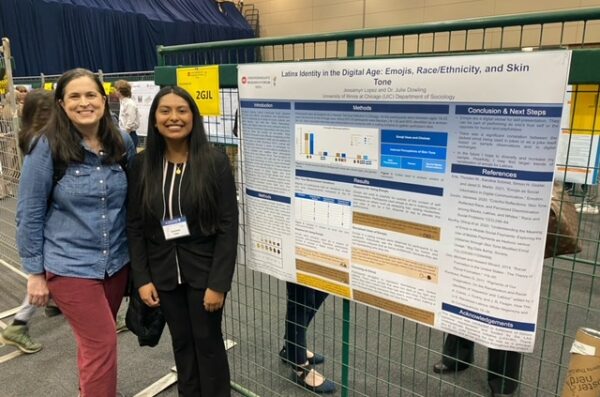
The department regularly offers events for the entire department where sociologists, both from UIC and other universities, give research presentations. Undergraduates are always welcome to attend these events!
The Middle (Career Exploration Events)
Special events and panels are held several times a year that give students the opportunity to learn more about the many career pathways that Sociology majors embark upon after graduation. Our “Sociologists at Work” series brings working professionals and academics to campus to meet with you and answer your questions about career pathways.
The End
Sociology 490. This capstone course, “Igniting Sociological Futures” comes at the end of your time at UIC, and digs deeper into the question of “What comes next?” in two ways. First, you will gain valuable professional networks, and hone your sociological knowledge and skills through your work with a local non-profit. Second, you will be guided through a series of projects tailored to your personal ‘what comes next’ goal, so that when you graduate, you will have the skills, materials, and confidence to succeed at whatever comes next for you.
The Vibe: What’s the department like for undergraduate Sociology majors?
-
The Vibe: What’s the department like for undergraduate Sociology majors?
We have a welcoming vibe in our department that comes from...
-
Our faculty...
A recent survey of our students reported 99% of the respondents say they felt supported by the faculty.
-
Our students...
…are drawn to sociology because it offers tools to make a difference. In your classes, you’ll meet peers, TAs, and faculty who share that passion—and you can get involved through our Sociology Club, which hosts social–and sociological–events throughout the year.
-
Our staff...
…are excited to support our undergrads by helping us host intellectual events and just plain fun events to feed your mind, body and soul.