Graduate Students on the Market
Get to know our talented PhD students on the job market! UIC Sociology prepares graduate students for jobs in a variety of settings, including a range of higher education positions as well as research positions in government, for-profit industry, and non-profit and advocacy organizations.
Currently on the market: Erin Eife, Meghan Daniel, Cal Lee Garrett, and Enrique Alvear Moreno
Cal Lee Garrett (ABD) Heading link

Cal Lee Garrett (they/them) is a Ph.D. candidate in Sociology at the University of Illinois at Chicago.
Cal’s research focuses on the relationship between science and social inequalities. Specifically, they have studied how scientific evidence on the environment, the body, and the mind contributes to inequalities due to certain assumptions, even when scientists are committed to equity or justice.
Their dissertation is focused on how the health benefits of environmental amenities, like parks and nature preserves, are not evenly experienced across communities and contribute to patterns of environmental racism. Cal’s multi-method qualitative data uncovers how the cultural values, norms, and priorities of science, ecology in this case, are presumed be objective and universal but are in fact exclusionary. Nature ends up being cultivated for individuals and groups who have a personal interest in the value of science and are disproportionately white and affluent.
Cal’s other projects have focused on the politics of data in public health and theories of healthy gender identity in trans medicine. Each of these projects also reflects their methodological interest in ‘studying up’ by focusing on experts and leaders who are responsible for key decisions that shape the life chances of others. Their work often compliments community-based activism and public policy by contextualizing niche expert debates.
Writing by Cal has been featured in a public policy report published by the Institute for Research on Race and Public Policy at UIC and in journals such as BioSocieties, Sociology of Health & Illness, City & Community, and Parks Stewardship Forum. They have also reviewed books or articles for Gender & Society, Sexualities, and Social Science and Medicine.
Enrique Alvear Moreno (ABD) Heading link
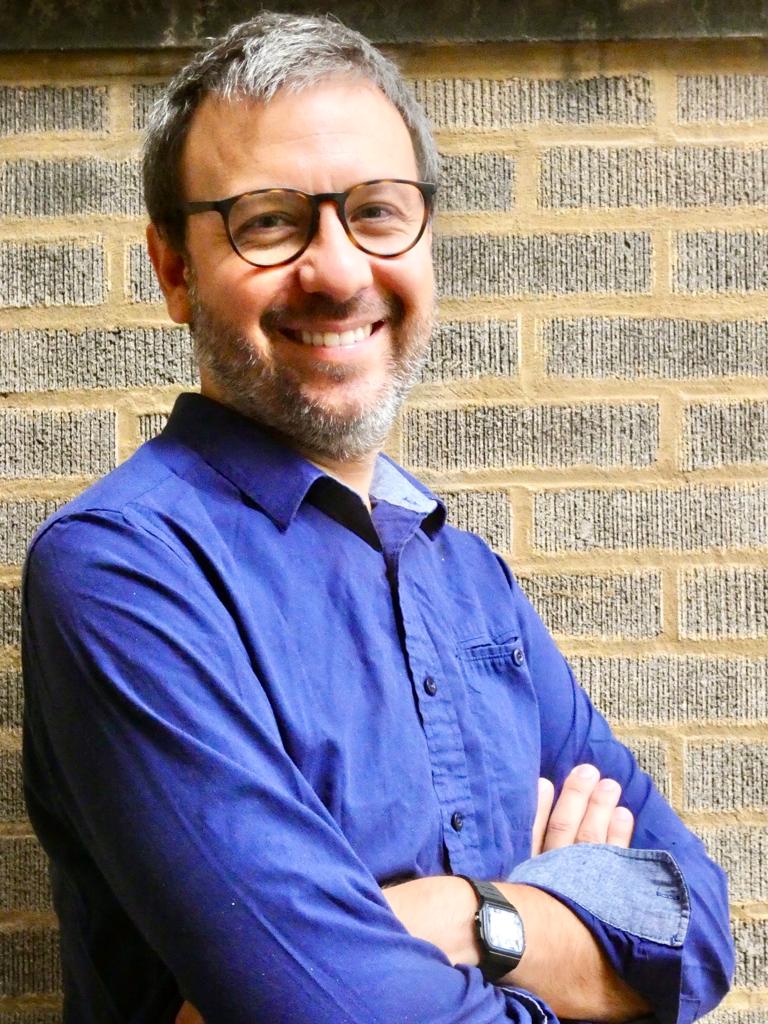
I am a Ph.D. candidate in the Department of Sociology at the University of Illinois at Chicago (UIC), and I also hold a Master’s in Latin American and Latino/a Studies. My research and teaching interests are urban policing, US empire and colonialism, international development, poverty governance, US sanctuary cities, and immigration control. My dissertation “Behind the Allure of Accuracy and Development: The Imperial Making of Predictive Policing in Santiago, Chile”, explores how and why the domestic shift to predictive crime control in the city was the result of global power relations that constrained and facilitated imperial flows of economic capital, expertise, and penal policies between the US and Chile. Drawing on 18 months of ethnographic fieldwork, including more than 120 hours of ethnographic observations within the national police, 68 in-depth interviews, and over 2,000 pages of archival materials, this project demonstrates that predictive policing emerged out of large macro-institutional arrangements between the Chilean government, the Inter-American Development Bank, Altegrity (a global risk consulting company led by William Bratton and based in New York city), and the national police.
My research has received generous financial support from the National Science Foundation, the American Sociological Association, the Social Science Research Council (SSRC) and the Andrew W. Mellon Foundation, the National Research and Development Agency (ANID) from the Chilean Government, Northwestern University’s and Social Science Research Council’s Dissertation Proposal Development Program, and the Provost’s Graduate Research Award from the University of Illinois at Chicago. As a member of the UIC Policing in Chicago Research Group, I have co-authored a book entitled Carceral Chicago: Weaponized Data and the Webs of Imperial Policing (forthcoming in 2024 with the University of Minnesota Press). Some of my other work has been published or under consideration at Law & Social Inquiry, Oxford Bibliographies in Criminology, Persona y Sociedad (Original in Spanish), and Revista Latinoamericana de Teología (Original in Spanish).
In addition to research, I am passionate about teaching. I understand education as a praxis that aims to help students from multiple biographies and social positions to (re)read the world in a way that allows us to scrutinize power and social inequality. In the United States, I have taught more than 500 college students either as a teaching assistant or instructor of record in the Sociology Department. Since UIC is the largest Minority Serving Institution in the city, I have developed a variety of pedagogical skills, methods, and forms of evaluation that pay attention to several disciplinary backgrounds, learning-styles, and knowledge and explicitly addresses my students’ unequal social positions in the classroom.
Get in touch at oalvea2@uic.edu
Meghan Daniel (ABD) Heading link

Meghan Daniel (she/her) is a Sociology PhD candidate and Gender and Women’s Studies concentrator at the University of Illinois at Chicago. Her research focuses on the politics of social movements, people’s lived experiences of organizing for social justice, reproductive justice, and intersecting systems of state control.
Meghan has years of experience researching abortion access within a reproductive justice framework. Her past work examines feminist leadership and margins to center organizing practices within an abortion fund, and can be found in a special issue of Mobilization. She has worked as part of a research team with Chicago Abortion Fund to investigate abortion stigma within pro-choice communities; the results of this qualitative project impacted on-the-ground cultural and communications strategy in Chicago and Illinois. She is also currently a co-investigator on a community-engaged research project examining the gendered, racialized, and classed landscape of abortion access in Illinois after the passing of House Bill 40, which allows Medicaid funding for abortion services. This project, based at Chicago Abortion Fund, centers people who have had abortions in order to shape change.
Her dissertation employs archival, in-depth interview, and ethnographic methods to examine the historical and contemporary connections between social movements for reproductive justice and against state violence. She finds that organizers use cultural tactics, such as artwork and storytelling, in addition to material ones, to drive organizing and shift movement frames, thus connecting people, organizations, and social movements. This work draws on scholarship from social movements, criminalization, culture, and race, class, gender to foreground the embodied experiences of organizers and ground them in deep histories of mobilization.
Her research has generated four peer-reviewed articles and one book chapter, and can be found in Sociology Compass (forthcoming), Mobilization, American Sociology Review, Sociology Compass, and Advances in Gender Research.
Erin Eife, Ph.D. (Post-Doc at Brown University) Heading link

Dr. Erin Eife is currently an NSF Postdoctoral Research Fellow at Brown University. She is primarily interested in the criminal legal system and how it acts as a stratifying mechanism for citizenship rights in the United States. Using the theoretical lens of “carceral citizenship,” she illustrates how people with connections to the criminal legal system experience an alternate form of citizenship which denies them basic rights and resources. She has explored this topic through two major threads: the experience of pretrial release and the relationship between race, class, and the criminal legal system.
My current book project investigates pretrial release, surveillance, and the citizenship rights of people awaiting trial in Cook County. Drawing on courtroom observations and 58 in-depth interviews, I illustrate how people on pretrial release experience punitive surveillance before their cases are adjudicated. My findings call into question the idea that all people are truly innocent until proven guilty.My current postdoc project continues to explore the inequality in pretrial. Using courtroom ethnography and in-depth interviews in two rural counties in the Midwest, I examine the relationship between race, space, and criminal courts.
.